What GPT-5.6 Can Do for You in Crypto, and How It Divides Work With Binance AI
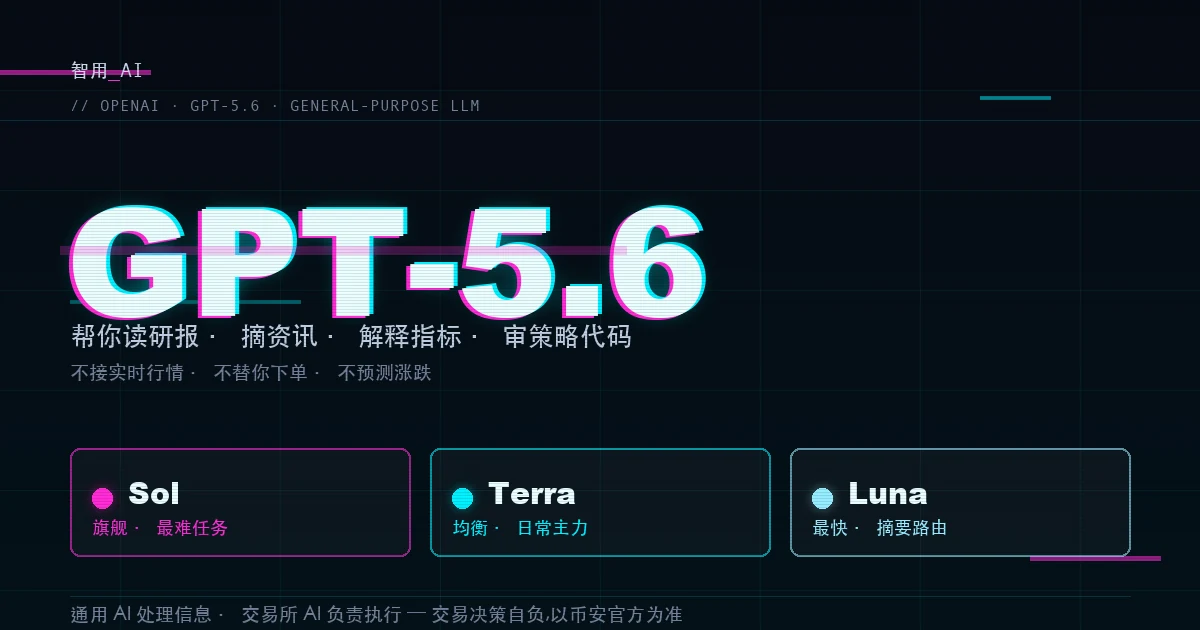
The moment GPT-5.6 launched, you probably saw two reactions in the group chats: one shouting that AI can now trade crypto for us, the other asking how this differs from that AI thing inside Binance. Let's settle it up front: GPT-5.6 is OpenAI's general-purpose large model, and it belongs to a completely different category from the AI assistant, grid bots, and strategy marketplace you tap open in the Binance app. The first is a brain that will discuss anything; the second is a set of hands and feet bolted into an exchange, working right up against the market and your account. This piece isn't about which tier scores higher on benchmarks. It's about one thing: what GPT-5.6 can genuinely do for you in crypto, what it can't touch at all, and how it should divide the work with the AI tools Binance ships.
What GPT-5.6 actually is (it isn't the AI inside Binance)
Let's place it first. GPT-5.6 is the new generation of large language model that OpenAI opened up on 9 July 2026 (a limited preview went out to a batch of users from 2026-06-26, and through July it rolled onto the OpenAI API, Codex, and GitHub Copilot). This time it isn't one model but a family, split into three tiers by capability and price:
- Sol: the flagship, built for the hardest work — complex coding and heavy-duty security analysis. The most expensive, and the one that chews through the tough problems.
- Terra: the balanced workhorse. OpenAI puts its performance at roughly the level of the previous GPT-5.5 at about half the price, and it's the tier meant for everyday work at scale.
- Luna: the fastest and cheapest, good at summarising, content routing, and simple automation.
The names are three celestial bodies, and from Sol to Luna the models get lighter, faster, and cheaper. But the point to hold on to isn't which tier is strongest — it's what all three share: they are general-purpose models, trained to handle text and information, not built for crypto trading and not plugged into any exchange. Which brings us to the line this piece is really about.
General model vs exchange AI: one table
The AI you meet inside Binance and GPT-5.6 are two different species. Confusing them is the root cause of nearly every beginner mistake with AI and crypto. Put simply:
- Binance's built-in AI (AlphaAI, Square AI, AI grids and trading bots) are tools the exchange built itself, living inside the platform. They can read live market data, they're connected to your account, and with your authorisation they can place orders — because that is exactly what they were made for. For a systematic tour of them, go back to The Full Guide to Binance AI & Smart Tools.
- GPT-5.6 is a standalone general-purpose brain. It doesn't know what BTC costs right now, it isn't connected to your Binance account, and it certainly can't press buy or sell for you. What it's good at is handling information: you feed it text, data, or code, and it helps you read it, untangle it, and write it up.
| Dimension | GPT-5.6 (general model) | Binance's built-in AI |
|---|---|---|
| Live market data | Doesn't know it, unless you paste it in | Wired into the order book by design |
| Connects to your account | Doesn't, and shouldn't | Can, with your authorisation |
| Places orders automatically | No | Yes (grids / bots) |
| Best at | Reading, writing, explaining, auditing code | Watching the market, generating signals, executing |
| Does it make things up | Yes (hallucination) — verify it yourself | Also gets things wrong, but works off real market data |
One line to keep: GPT-5.6 helps you think it through; Binance's AI gets it done on the platform. Miss that line and you end up with the idea of having GPT trade for you automatically, which is both impossible and dangerous.
Four crypto jobs GPT-5.6 can do for you
With the boundary drawn, here's where it actually helps. These four are the jobs GPT-5.6 genuinely earns its keep on:
- Reading research, whitepapers, and long articles. A forty-page project whitepaper or institutional report that you have no patience for — hand it over and ask it to break the thing down by team, token economics, roadmap, and risks, and you have the gist in ten minutes. It won't judge whether the thing is worth buying, but it saves you the slog of reading every page.
- Summarising news and pulling out what changed. Hundreds of industry stories a day; paste in an English announcement or a long thread and have it compressed into three sentences with the key changes flagged. Square AI on Binance does this too — to compare the two, see How to Use Square AI; the difference is that GPT-5.6 is more general and doesn't care about the source, so you can feed it text from anywhere.
- Explaining metrics and terms you don't follow. Why a funding rate goes negative, what realised volatility means, how to read a chain's TVL — throw the jargon at it, ask for plain language, then ask for an example. Use it as a tutor who's always available and never thinks your question is stupid. For how much weight to put on the market interpretation AI gives you, read this alongside How to Read AI Market Analysis.
- Auditing strategy code and hunting bugs. If you write a bit of quant scripting or use the API, GPT-5.6 — Sol in particular — is good at reading code, finding logic holes, and explaining what a chunk of it does. Ask it whether an order-placing script has the leverage wrong or is missing exception handling, and it'll get there faster than most beginners debugging alone.
What those four share: they're all information handling — read, summarise, explain, audit. None of them touches your money or the live order book; they just speed up your head.
Four things GPT-5.6 can't do (where the risk lands)
Now the more important half — what it can't do and what you must not count on it for. Carve these into your memory and you'll dodge most of the AI-trades-crypto traps:
- It can't give you live market data. GPT-5.6 isn't plugged into the order book. Ask it what BTC costs right now and it will either say it doesn't know or hand you a stale price from its training data with a perfectly straight face. For live prices, always look at the Binance market page, never at it.
- It can't place orders for you. It's a chat model, not connected to an exchange and with no trading permissions. Automating a strategy is the job of Binance's grids and trading bots — see How to Use Trading Bots. And be wary of tutorials promising that hooking GPT up will trade for you automatically: plenty of them are after your API keys, and even the legitimate self-built scripts require you to understand both the code and the risk controls, which is no place for a beginner.
- It can't predict which way prices go. This is the fatal misconception. Ask it to predict whether ETH rises or falls tomorrow and it will certainly produce something that reads convincingly — but that is language patterns arranged into a plausible answer, not a judgement about the future. No model predicts markets reliably, and it least of all.
- It will state nonsense with total confidence (hallucination). The common failing of large models: when it doesn't know, it invents, in convincing detail — fake prices, projects that don't exist, wrong numbers, all delivered without hesitation. So every statement it makes that involves data or facts is something you have to check against an official source yourself.
Sol / Terra / Luna: which tier for which crypto job
Down to which one to actually use. Don't let the three models tangle you up; sort them by the job in hand:
- Most day-to-day work (reading research, summarising news, explaining metrics) — use Terra. It's the balanced workhorse, performing at roughly the level of the previous GPT-5.5 for about half the price, capable enough without burning money. When in doubt, default to it.
- The hard stuff (auditing fairly complex strategy code, chewing through security questions) — go to Sol. The most expensive, and the one that holds up on difficult problems, which earns back the cost.
- Light work only (compressing long text into short summaries, simple classification and automation) — use Luna, the fastest and cheapest.
If you're going through the API and paying by usage, the rough pricing runs like this (per million tokens, input / output):
| Tier | Input / output (per million tokens) | Suits |
|---|---|---|
| Sol | $4 / $20 | Flagship · hardest tasks |
| Terra | $2 / $12 | Balanced · everyday workhorse |
| Luna | $0.20 / $1.20 | Fastest and cheapest · summaries / routing |
Those are the rates as checked against the official pricing page in August 2026. For the record: at launch on 9 July 2026 the three tiers were Sol $5 / $30, Terra $2.5 / $15 and Luna $1 / $6, and OpenAI has cut them once since. Go by OpenAI's own pricing page, which can change at any time. Most crypto users never touch the API anyway — on the web version you just pick the model — so remember one line: start on Terra, step up to Sol when it isn't enough, and hand the light work to Luna. That's the same reasoning as the choice inside Binance between starting with smart tools and practising by hand, which you can compare in Smart Strategies vs Manual Trading.
Putting GPT-5.6 and Binance's AI to work together
Finally, let's fit the two sides together into a division of labour you can actually use. Treat GPT-5.6 as the adviser and Binance's built-in AI as the executor, and a full pass looks roughly like this:
- Understand it with GPT-5.6 first. When a new project report or an important announcement lands, hand it to Terra and have it broken down, summarised, and any metric you don't follow explained — this step is about working out what happened.
- Go back to Binance to verify the live numbers. However well GPT-5.6's reasoning flows, anything involving prices, rates, or the order book goes back to the Binance market page and the official announcements for a check. It explains; Binance supplies the real figures. For what Binance's own AlphaAI contributes at this stage, see What AlphaAI Is.
- Execute with Binance's built-in tools. Automatic buying low and selling high, DCA, or following a strategy is the work of grids and trading bots — they're connected to your account and place orders by rule, which GPT-5.6 can't do and shouldn't.
- Keep the decision and the risk control in your own hands. AI can read for you, calculate for you, and execute for you, but whether to act, how much to put in, and where the stop-loss goes are always yours. A tool speeds you up; it doesn't replace your judgement.
The whole division of labour in one sentence: let the general AI handle information, let the exchange AI execute against the market, and hold the verify-and-decide line yourself. The way this most often goes wrong is collapsing the three steps into one — asking GPT what to buy and how much, then placing the order on the answer it invented. It has neither live prices nor any idea of your position, so using it that way is driving blindfolded.
FAQ
Can GPT-5.6 predict which way a coin will move?
No, and don't count on it. GPT-5.6 is a general-purpose model for handling text and information; any prediction it hands you is language patterns arranged into a plausible sentence, not a judgement about the future, and it doesn't even know the current live price. Markets move on supply, demand, flows, and sudden news, and no model predicts that reliably. Use it to read research and untangle logic; treat it as a price oracle and it will cost you eventually.
Of GPT-5.6's Sol, Terra, and Luna tiers, which one should I use day to day in crypto?
Terra is enough for most situations. It is the balanced workhorse, with OpenAI putting its performance at roughly the level of the previous GPT-5.5 for about half the price, and it handles the everyday work of reading research, writing summaries, and explaining metrics. Move up to the flagship Sol when you want fairly complex strategy code audited or hard security questions chewed through; use the fastest and cheapest Luna when you are only compressing long text into short summaries or doing simple classification and routing. Start on Terra and step up only when it falls short.
Can GPT-5.6 connect to my Binance account and place orders for me?
No, and don't go wiring it up. GPT-5.6 does not connect to your Binance account by default, will not place orders for you, and should certainly never hold your withdrawal permission. The things that actually execute automated trades inside Binance are Binance's own built-in tools, the grids and trading bots. If you want a strategy executed automatically, use those built-in bots; if you want AI to help you think the logic through, that is the job for GPT-5.6. The two have to stay separate.
With GPT-5.6 around, are Binance's own AI tools still useful?
Yes, because they do different jobs. GPT-5.6 is a general model, strong at handling information: reading research, summarising news, explaining metrics you don't follow. Binance's built-in AlphaAI, Square AI, and grid bots are strong at working right up against the market and your account: watching prices, generating signals, executing automatically. One helps you think it through, the other gets it done on the platform; neither replaces the other, and pairing them is the least effort.
Wrap-up and next steps
To close it out. GPT-5.6 is a very capable general-purpose model, and reading research, summarising news, explaining metrics, and auditing code are places where it genuinely saves you mental effort. But by default it isn't connected to live market data or to your account, it won't place orders for you, it certainly can't predict prices, and it will get things wrong with a straight face. It doesn't replace Binance's built-in AI; the relationship is a division of labour — one helps you think it through, the other gets it done on the platform, and the verifying and deciding in between are permanently your job. Hold that boundary and no amount of AI-earns-you-money patter will pull you off course.
For what to read next, I'd pick these:
- To see which AI tools Binance has of its own and how to start with them, see The Full Guide to Binance AI & Smart Tools.
- To work out how much weight AI market interpretation deserves, see How to Read AI Market Analysis.
- If you're torn between leaning on tools and practising by hand first, see Smart Strategies vs Manual Trading.
For GPT-5.6's latest capabilities and pricing, go by OpenAI's own pages, which can change at any time; to fill in the basic concepts of the crypto world, Binance Academy has systematic explainers worth reading alongside (checked 2026-07).